By Andy Flick, Evolutionary Studies scientific coordinator
New research sheds light on a key driver of evolution in mammals: the length of pregnancy. By examining the diverse gestation periods across 845 species of eutherian mammals, including everything from mice to whales, scientists have uncovered surprising patterns that hint at how these varying timelines evolved and adapted to environmental pressures over millions of years.
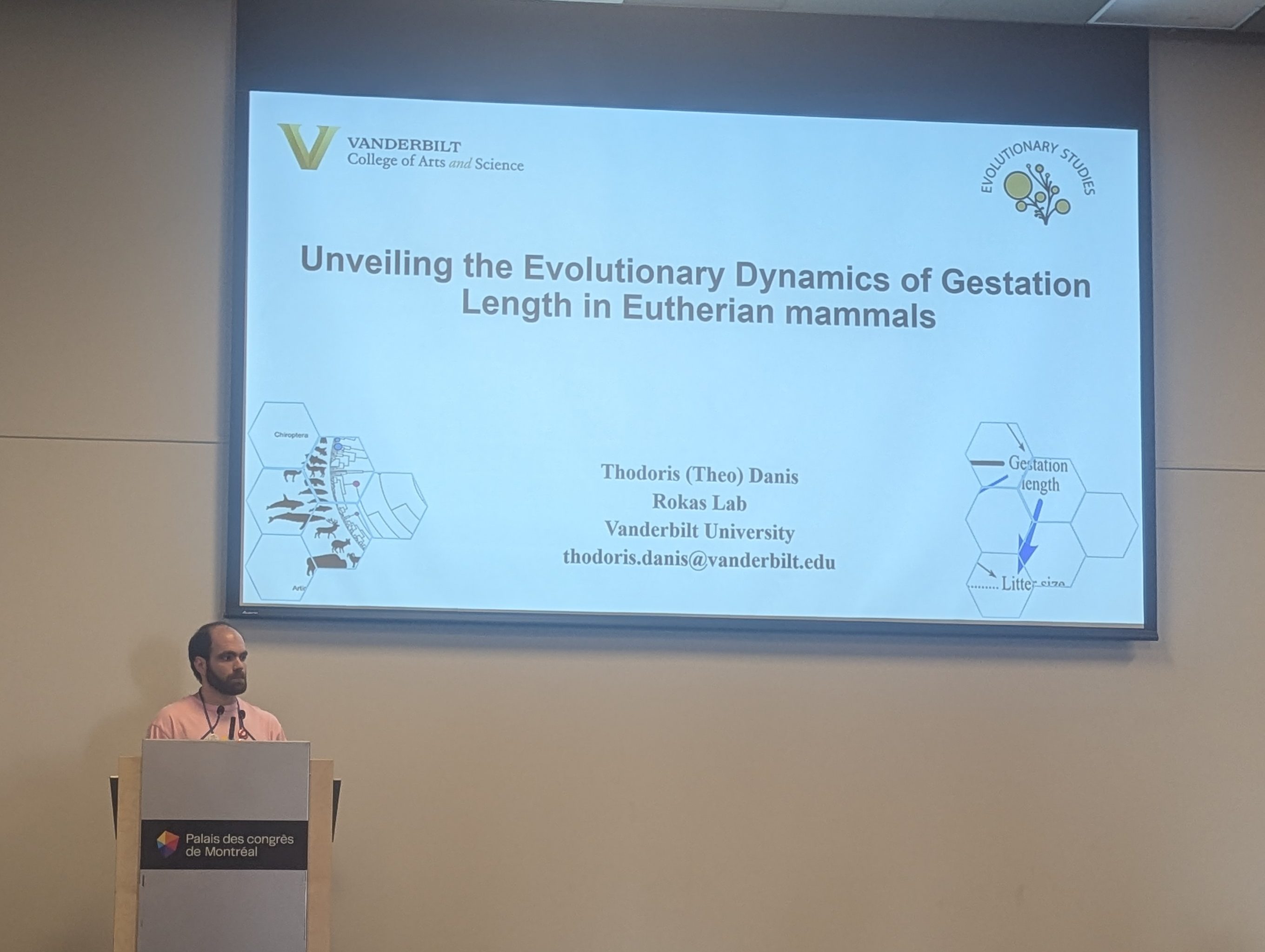
The work, led by graduate student Thodoris Danis, was published in the Proceedings of the Royal Society: B on October 30th, 2024. “The Evolution of Gestation Length in Eutherian Mammals,” was a collaborative effort between Danis and his advisor, Cornelius Vanderbilt Chair in Biological Sciences Antonis Rokas.
Contrary to popular belief, Danis found that gestation length does not strongly depend on body size across all mammals. This popular belief was not unfounded; though, most studies of gestation length and body mass looked at relatively few species from well-studied groups, such as the primates. Following that, the pair found many groups of mammals did have strong, positive relationships between body mass and gestation lengths. These groups included primates, rodents, carnivores, and artiodactyls like elk and bison. However, the link between the two traits is simply absent in many other groups.
For example, the team found that bats, seals, and perissodactyls like zebras and rhinos did not have any correlation between body mass and gestation length.
Why does the relationship between gestation length and body mass vary between mammals? According to Danis, key shifts in evolutionary trajectory often coincide with major splits in the tree of life. Notable shifts occurred when mammals returned to the water – gestation lengths become longer — likely as an adaptation to marine life. Conversely, when mammals took to the skies, gestation lengths shortened. This seems to occur, in Danis’ mind, because the ecological environments of marine and flying mammals are vastly different from those of terrestrial mammals.
Citation: Danis T, Rokas A. (2024) The evolution of gestation length in eutherian mammals. Proc. Biol. Sci
Funding Statement: Support provided by Burroughs Wellcome Fund and the March of Dimes Prematurity Research Center. The Rokas lab is supported by NSF (DEB-2110404) and NIH/NIAID (R01 AI153356).
 Eco Flick Lab
Leave a comment